Ingredients & Evidence
Joint Glide Ingredients: What's Really Inside?

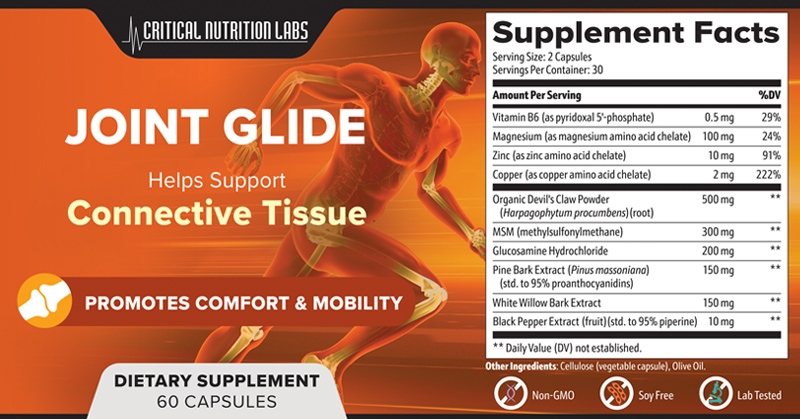
Joint Glide earns real credit for transparency: it prints its full Supplement Facts panel, every ingredient with its exact dose and no proprietary blend. That makes it easy to do the honest thing and check each one against the research. The short version: the pine bark extract and mineral cofactors are genuinely well chosen, the pain herbs are reasonable, and the two best-known cartilage builders, glucosamine and MSM, are dosed lighter than the studies.
The hero: pine bark extract
Pine Bark Extract (Pinus massoniana, standardized to 95% proanthocyanidins), 150 mg. This is the formula's centerpiece and its strongest pick. Pine bark proanthocyanidins are the same antioxidant class as the well-studied French maritime extract Pycnogenol, and they have published research for easing osteoarthritis symptoms and dampening the activity of cartilage-degrading MMP enzymes (the "rust enzyme" the marketing leans on). Crucially, it's properly standardized to 95% proanthocyanidins, so the 150 mg is a meaningful, study-relevant dose rather than filler.
The pain-support herbs
Organic Devil's Claw, 500 mg (root powder). Devil's claw has a real track record for joint pain, with some trials showing relief comparable to certain anti-inflammatories; its active is harpagoside. The honest caveat: this is whole-root powder, not standardized to a guaranteed harpagoside content, so the actual active dose can vary batch to batch. 500 mg of powder is a fair amount, but a standardized extract would be more reliable.
White Willow Bark Extract, 150 mg. The original "natural aspirin." Willow bark supplies salicin, the plant precursor to aspirin's active compound, along with catechin antioxidants that help protect collagen. It's a sensible pain-support inclusion. Note: because it's salicin-based, it's the ingredient to clear with your doctor if you're aspirin-sensitive or on blood thinners.
The cartilage builders (the lighter doses)
MSM (methylsulfonylmethane), 300 mg. MSM is a sulfur donor used in collagen and connective tissue, with some evidence for joint comfort, but most positive studies use 1,500–3,000 mg per day. At 300 mg, this is a supportive nod rather than a clinical dose.
Glucosamine Hydrochloride, 200 mg. Glucosamine is a classic cartilage building block, but the trials that show benefit typically use around 1,500 mg per day (and even then the evidence is mixed). At 200 mg, it's well below that, so don't expect it to drive results here.
The collagen mineral cofactors
This trio is the formula's most thoughtful touch, because these minerals are exactly what your body needs to actually build and stabilize collagen, and most joint products ignore them:
- Magnesium (amino acid chelate), 100 mg. A well-absorbed chelated form; magnesium supports the chondrocyte cells that maintain cartilage.
- Zinc (amino acid chelate), 10 mg. A required cofactor for collagen production.
- Copper (amino acid chelate), 2 mg. Copper-dependent enzymes cross-link and strengthen collagen fibers, which is why zinc and copper are sensibly paired here. One note: 2 mg is above the daily value, fine on its own, but don't stack it with other copper supplements long-term.
The absorption helper & active B6
Black Pepper Extract (95% piperine), 10 mg. Piperine meaningfully improves the absorption of the other actives, a smart, evidence-based inclusion. Vitamin B6 (as pyridoxal 5'-phosphate), 0.5 mg is the body-ready "active" form of B6 and plays a supporting role in turning raw materials into collagen. The capsule itself is cellulose (vegetarian) with a little olive oil; the label notes non-GMO, soy-free, and lab-tested.
View Joint Glide on the Official Site 60-day money-back guarantee
For the full picture, read our main Joint Glide review, the pricing & guarantee details, or the side effects & safety guide.
Statements about this product have not been evaluated by the Food and Drug Administration. Joint Glide is not intended to diagnose, treat, cure, or prevent any disease. This content is not a substitute for professional medical advice.